
>It's not easy to predict the market. But there are at least two positive factors to back the PSU banks, explains Tamal Bandyopadhyay.

Omkeshwar Singh, Head, Rank MF, a mutual fund investment platform, answers your queries

'The long maturity of these funds makes them well-suited for long-term financial goals such as saving for retirement or children's education or marriage.'

The IPO is an offer for sale of 38 million shares by SBI, BOB, LIC, PNB and T Rowe Price. Barring T Rowe and PNB, the others are selling stake to comply with Sebi norms.

While three of the top five FPIs - Capital, Government of Singapore, and Vanguard - have seen their investment value more than triple, India's benchmark indices have risen just 70%.

The agency has issued a provisional order attaching the farmhouse located in south Delhi's Mehrauli area under the provisions of the Prevention of Money Laundering Act. It said the book value of the asset is Rs 6.61 crore but its market value is "worth Rs 27 crore and is in the name of Maple Destinations & Dreambuild".

Nikunj Saraf, Vice President Choice Wealth, answers your queries.

Mutual funds provide the right opportunity to the millions of investors

Housing Development Finance Corp (HDFC) chairman Deepak Parekh on Tuesday said that while the country's macroeconomic fundamentals remain strong and the recovery is in progress, the unpredictability of coronavirus will remain a key challenge. Owing to the second wave, the Indian economy is likely to mirror a similar trend seen in FY21, where the first half of the financial year is weaker and the second half is significantly stronger, he said. "I remain confident that India's macroeconomic fundamentals are strong. Recovery is underway," Parekh said while addressing the 44th annual general meeting of HDFC Ltd. He said, the country's forex reserves and foreign direct investment inflows have scaled record highs, the capital markets are also buoyant and agriculture growth is expected to remain strong with food grain production estimated at over 305 million tonnes.

Domestic equity investors' wealth eroded by more than Rs 4.43 lakh crore on Monday as fears of a financial contagion triggered by one of the biggest bank failures in the US roiled market sentiments. After a strong opening, Indian stocks went into a tailspin with the benchmark 30-share BSE Sensex tumbling nearly 900 points to close at 58,237.85 points -- sliding for the third straight trading session. The NSE Nifty too declined 258.60 points to end at 17,154.30 points.

From the Sensex pack, NTPC, Tata Motors, Titan, Larsen & Toubro, Reliance Industries, IndusInd Bank, Infosys, HDFC Bank and Power Grid were among the major gainers. Wipro and Tech Mahindra were the laggards.

Corrective measures are already being taken by fund managers - overall allocation to the IT firm has been pruned by 120 basis points, from 4.43 per cent in March to 3.24 per cent in July

Gold has risen sharply due to rising risk aversion

Aided by the $57.8-billion merger of HDFC Bank and HDFC, India Inc reported its highest ever mergers and acquisitions in calendar 2022 at $171 billion as against deals worth $145 billion announced last year. The acquisition by the Adani group across cement, media and ports dominated the headlines with the conglomerate making its foray into the cement sector by buying Swiss materials firm Holcim's stake in Ambuja Cements for $6.5 billion. The Adani family's additional $4-billion open offer for Ambuja did not get a response because shareholders preferred to stay invested with the new owner.

Mergers and acquisitions (M&As) in India are expected to stay buoyant, seen over the last three-four years, despite a slowdown in the first seven months of the calendar year. "M&A is a lumpy business activity, and we may suddenly see large deals taking place during the next two quarters of the calendar year. "This would help maintain the streak of strong M&A activity.

Financial planners advise against putting capital to work by anticipating what might go up or down.

Health issues, divorce, court battles, moral turpitude, and more can all distract the CEO and impinge on a company's performance. So, how much of their private life should a company disclose? asks Amit Tandon.

Co-founder Nilekani could take the role of non-executive chairman, becoming a bridge between the board and Murthy, reports Ayan Pramanik.

Omkeshwar Singh, Head, Rank MF, a mutual fund investment platform, answers your queries.

If you want to invest in mutual funds, but don't want your investment to dip below market returns, then you must know the difference between 'active' and 'passive' investing.
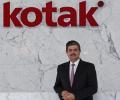
Ahead of the end of his term as the Kotak Mahindra Bank's chief executive and managing director, Uday Kotak has said he will be a "non-executive board governance member and a strategic shareholder" going ahead. In the private sector lender's annual report, the last such message from him as the MD and CEO before he relinquishes the position at the end of 2023, Kotak reminisced about the institution's journey, pointing out that Rs 10,000 invested in 1985 is worth over Rs 300 crore today. "Going forward, I see my role as a non-executive board governance member and a strategic shareholder with a long term perspective of nurturing a world class institution," Kotak said in the annual report.

rediffGURU Ramalingam Kalirajan answers your personal finance queries.

Only NIIF has stayed the course as a viable infrastructure financing institution.

Investors can sell their entire equity and move to debt when stocks get expensive

Neelesh Surana, who manages Mirae Asset Tax Saver and Mirae Asset Emerging Bluechip, remains constructive on Indian equities from a three to five-year time frame.

Fresh buying by domestic institutional investors and better-than-expected June quarter results from some blue-chip companies boosted investor sentiment

Omkeshwar Singh, Head, Rank MF, a mutual fund investment platform, answers your queries.

Omkeshwar Singh, head, Rank MF, a mutual fund investment platform, answers your queries.

LIC identifies the problems well, but what the markets will watch is how nimble it is with the solutions.

'Gold could return 10% to 12% in the next two-three years.'

'India is an equity market with a breadth and depth of companies to invest in.'

'When you have surplus cash flow and markets correct sharply, what options do you have other than buying good stocks?'

rediffGURU Dev Ashish answers your personal finance and mutual fund queries.

The Sensex ended up 48 points at 28,386 and the Nifty gained 13 points to close at 8,476.
In the 52 newly listed companies since 2014, fund managers have a total investment of a mere 2.5 per cent of their assets under management.

YES Bank, Bank of Baroda, SBI, IndusInd Bank, and RBL Bank are amongst the banks, Jefferies says, are most prune to "high risk" emanating from ADAG, Cox & Kings, CG Power, DHFL and Essar Shipping.

While the proposed new tax regime is optional for taxpayers, the finance minister has said the government eventually wants to do away with all exemptions with a lower tax-rate simplified structure.

'Returns can be very variable in equity markets.' 'That is why I tell small investors don't put 100 per cent of your money in equities, even if you are young.'
 © 2026 Rediff.com - Advertise with us - Disclaimer - Privacy Policy - Sitemap - Feedback - About us - Terms of use - Grievances